 Serum
Serum fees varied by trading tier and remained separate from Solana transaction charges
Serum fees were trading charges on executed orders, with separate SOL costs for Solana transactions. The original mainnet program became defunct in November 2022. In the later legacy schedule, ordinary-market taker rates ranged from 4 basis points (0.04%) to 3 basis points (0.03%). Makers paid no trading fee under that schedule. SRM or MegaSerum (MSRM) balances qualified eligible orders for lower tiers when a valid discount account accompanied them. Certain designated markets used a separate rate. Account creation required additional SOL funding, which differed from a spent transaction fee. A quoted trading percentage covered the execution charge, leaving transaction costs and account deposits outside that rate.
Filled quote value and the fee calculation
A legacy taker charge depended on executed quote value and the applicable rate, with separate amounts for network fees and account funding.
Executed value in the quote token
The quote token denominated the market's prices; the base token was the asset being bought or sold. Executed base quantity multiplied by its execution price gave quote value. Ignoring native-unit rounding, the trading fee equalled that value multiplied by the basis-point rate and divided by 10,000. One basis point meant 0.01%.
A taker buy spent quote tokens on the purchase and its trading fee. A taker sell received quote proceeds after deduction of its fee. SOL transaction charges used a different calculation. Totalling those costs required a common reporting currency and an exchange rate appropriate to the historical transaction.
Native units and buy budgets
The program worked in native token units, the smallest whole units permitted by the token's decimal precision. Its taker-fee function rounded a fractional result upward to the next native quote unit. Small trades could therefore show an effective percentage above the nominal tier. A fee display rounded for readability could conceal that difference.
A buy instruction's maximum quote amount included fees. For taker fills, the purchase and its fee shared the quote budget. The matching engine allowed for the taker charge when determining affordable execution. Funds reserved for an order also differed from the final amount spent on matched quantity.
Token holdings and the later legacy tiers
The later ordinary-market tiers used the SRM or MSRM balance in the discount account supplied with the order. The later ordinary-market base taker rate was 4 basis points of executed quote value. Holding 100 SRM qualified for 3.9 basis points; 1000 SRM qualified for 3.8. The higher SRM thresholds were 10,000, 100,000, and 1,000,000 tokens, with rates of 3.6, 3.4, and 3.2 basis points, respectively.
| Later legacy tier | Taker rate | Discount-account control |
|---|---|---|
| Base tier | 4 basis points (0.04%) | No discount token account required |
| 1000 SRM to below 10,000 SRM | 3.8 basis points (0.038%) | SRM account owned by the order signer |
| At least 1 MSRM | 3 basis points (0.03%) | MSRM account owned by the order signer |
The discount account established the fee tier; the payer account supplied the trading tokens. The DEX checked the discount account's mint, balance, and owner. It did not require the SRM balance to be spent as the trading fee. An increase between tier thresholds left the rate unchanged. Discount holdings remained separate from SOL needed for transactions and account storage.
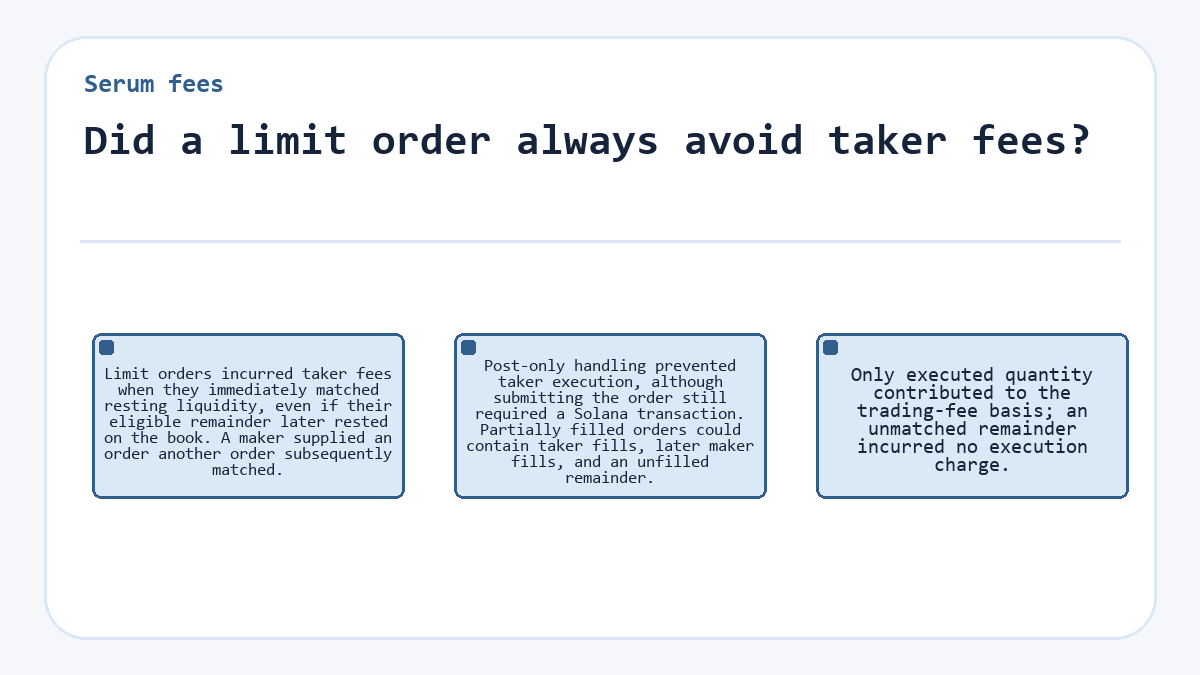
Did a limit order always avoid taker fees?
Limit orders incurred taker fees when they immediately matched resting liquidity, even if their eligible remainder later rested on the book. A maker supplied an order another order subsequently matched. Post-only handling prevented taker execution, although submitting the order still required a Solana transaction. Partially filled orders could contain taker fills, later maker fills, and an unfilled remainder. Only executed quantity contributed to the trading-fee basis; an unmatched remainder incurred no execution charge.
Solana fees and recoverable account funding
SOL funded transaction processing and the accounts needed for trading, but those amounts had different accounting treatment.
Transaction processing
Solana transactions charged a base fee, with an additional prioritization fee when configured. The transaction's fee payer supplied SOL. The legacy exchange's SRM discount did not alter this network charge. Order placement, cancellation, and settlement could each involve on-chain instructions, so their transaction fees belonged in the total cost of trading.
Several instructions could share one transaction. Counting orders or settlements therefore did not determine the number of network fees. Each charged transaction added a base fee per signature, plus any configured prioritization fee. Settlement transferred available trading balances back to token accounts; it did not create another matched trade.
Storage deposits
The minimum SOL funding for a rent-exempt account depended on its allocated data size. The legacy TypeScript client created a market-specific OpenOrders account when none existed for that owner. Creation required the rent-exempt balance. Reusing an existing account avoided creating it again. That funding remained in the account instead of disappearing as a trading charge.
The legacy close instruction required every order slot to be free and both total token balances to be zero. An eligible closure transferred the account's SOL to its specified destination. Recoverable storage funding reduced available wallet SOL while the account existed, but it differed from a permanently spent network fee.
Swap legs and discount support
Legacy direct swaps used one market, while transitive swaps executed across two markets sharing a quote token. Each matched trading leg had its own fee basis. The sell charge reduced the quote proceeds available for the buy leg, whose budget also included its fee. Both legs could execute within one swap instruction, so they did not inherently require two separately charged network transactions.
The legacy swap program's direct and transitive entry points omitted the optional SRM or MSRM discount account. Holding the token alone therefore did not establish a discount for those methods. Designated-market pricing still followed the DEX's market rules. This interface limitation differed from direct DEX order instructions, which accepted a discount account.
Historical schedules and designated-market exceptions
Earlier legacy pricing included higher taker charges and maker rebates, so historical fee tables belonged to distinct schedules. The earlier ordinary tiers ran from 22 basis points at the base tier to 10 basis points for MSRM. Makers received 3 basis points under most earlier tiers and 5 under MSRM. Later ordinary-market pricing used zero maker fees and rebates. Combining an earlier maker rebate with a later taker rate would describe neither schedule.
FTX controlled the original Serum program's upgrade authority, creating security concerns during the November 2022 collapse. OpenBook continued as a community fork deployed under a different program identity. Shared code ancestry did not make every replacement market subject to Serum's historical fees.
Special-market treatment depended on the market address. The later DEX fee logic tested designated addresses before evaluating SRM or MSRM holdings. An asset's stable price or a familiar pair name did not automatically activate that branch. For those designated markets, the later legacy taker rate was 1 basis point (0.01%) of executed quote value.
Details worth knowing about Serum fees
-
Were SRM balances across separate token accounts combined for one fee discount?
- The legacy DEX evaluated the balance of the single discount token account supplied with an order. It did not sum every SRM account belonging to the signer. Several smaller balances could therefore produce a different qualifying tier from the same total held in one eligible account.
-
Did a referral add a surcharge to Serum's taker fee?
- The legacy DEX referral mechanism allocated part of the existing taker fee without adding a referral surcharge. A compatible quote-token account could receive the accrued referral rebate during settlement. That allocation concerned the recipient of fee revenue and did not increase the taker rate.
-
Was buying SRM elsewhere subject to the Serum DEX fee schedule?
- Buying SRM on another exchange followed that exchange's fee rules. Serum's historical tiers applied to orders its DEX program executed, regardless of whether SRM was the asset being traded. A token listing elsewhere did not apply the Serum program's trading charges to that venue.
-
Why could a failed Serum transaction still cost SOL?
- A failed Serum transaction could still incur a network fee if it reached on-chain execution. Solana collected the fee before running the instructions and retained it when execution failed. An error before submission did not establish that the network had charged a fee.
-
Was SRM burned directly from a trader's wallet to pay the trading fee?
- A Serum execution fee debited the market's quote token without directly burning SRM from the trader's wallet. Historical fee policy directed a portion of revenue toward buying and burning SRM. That use of revenue differed from the token debit the matching engine applied to a trade.